


Synthesis of magnetite nanoparticles with different sizes for application in DNA extraction from biological sample
- Đại học Y Dược Thành phố Hồ Chí Minh
- Trường Đại học Khoa học Tự nhiên, ĐHQG-HCM
- Phan Chau Trinh University
- Viện Vật lý Thành phố Hồ Chí Minh
Abstract
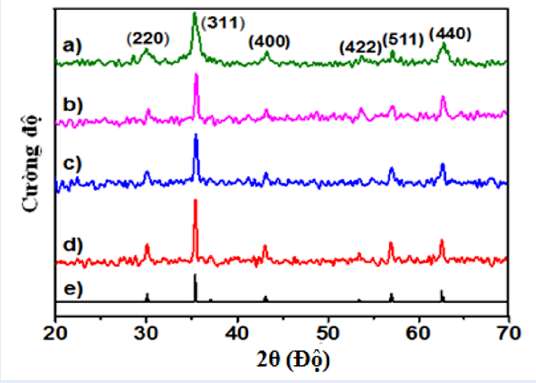
Serum samples containing hepatitis B virus (HBV) used as biological sample to examine DNA extraction capability at different nanoparticles (NPs) sizes and amounts were investigated in this study. The magnetite (Fe3O4) NPs synthesized by co-precipitation method were size about of 10 nm with the magnetic saturation of 60.02 emu/g. Using solvothermal method with different synthesis times obtained the Fe3O4 NPs sizes of about 32, 60 and 100 nm with the magnetic saturations of 88.82, 83.69 and 80.29 emu/g, respectively. The synthesized Fe3O4 NPs had superparamagnetic properties. By Stöber method, the Fe3O4 NPs were coated with SiO2 (Fe3O4@SiO2) to form Si-OH groups through which the NPs could adsorb DNA via hydrogen bonds. The properties, morphology, size and DNA adsorption capacity of the NPs were determined by X-ray diffraction (XRD), transmission electron microscopy (TEM), vibrating sample magnetometer (VSM), Fourier transform infrared spectroscopy (FTIR), Brunauer–Emmett–Teller (BET) method, and polymerase chain reaction (PCR). The results showed that synthesized Fe3O4@SiO2 NPs could extract HBV DNA. The Fe3O4@SiO2 NPs obtained from 10 nm Fe3O4 NPs had better HBV DNA extraction. At high HBV concentration (109 copies/mL), using 3 or 4 mg of Fe3O4@SiO2 NPs (10 nm Fe3O4) could extract more HBV DNA than using 2 mg.