


Efficiency calibration for HPGe detector by Monte Carlo efficiency transfer method
- Nuclear Technique Laboratory, University of Science, VNU-HCM
- Department of Nuclear Physics, Faculty of Physics and Engineering Physics, University of Science, VNU-HCM
- 1. Nuclear Technique Laboratory, University of Science, VNU-HCM
- 2. Department of Nuclear Physics, Faculty of Physics and Engineering Physics, University of Science, VNU-HCM
Abstract
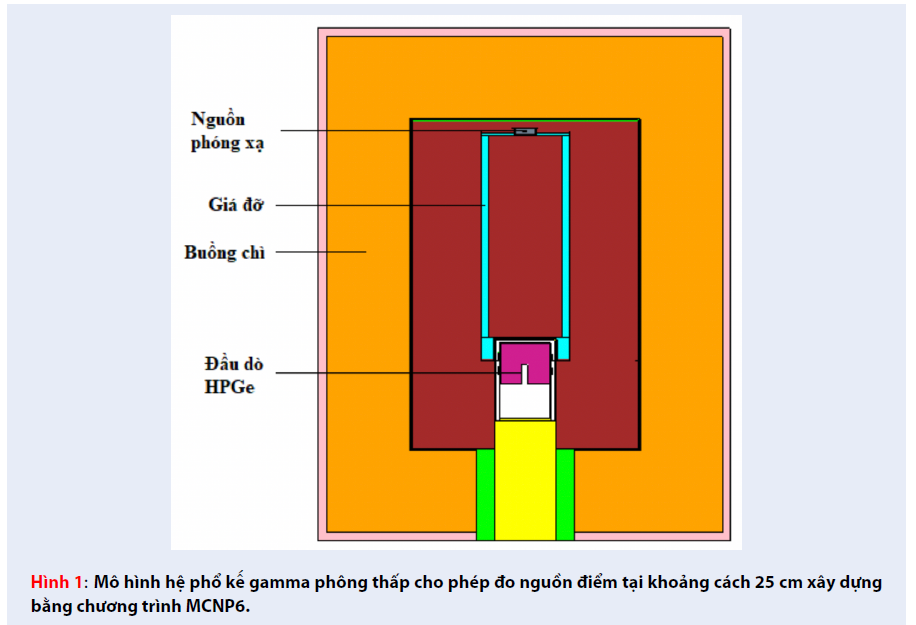
In this paper, the Monte Carlo efficiency transfer method was used to calibrate the full energy peak efficiency (FEPE) of a coaxial p-type HPGe detector. The gamma standard radioactive sources including 22Na, 54Mn, 57Co, 60Co, 65Zn, 109Cd,133Ba, 137Cs, 154Eu, 207Bi, 241Am were measured at different positions on-center of detector with the distance of 5, 10, 15, 20, 25 cm. Besides, a cylindrical sample containing standard mixed nuclides solution was also measured at surface of the detector. The experimental FEPE curves as function of gamma energy for these geometries were determined with the coincidence-summing corrections. A HPGe detector model based on the specifications of manufacturer was built to directly calculate the FEPE for the geometries by Monte Carlo simulations with MCNP6 code. However, these simulated FEPEs show a quite high discrepancy from experimental FEPEs. Then, the FEPEs were calculated by the efficiency transfer method with the efficiency curve for point source at distance of 25 cm as the reference data. A good agreement was obtained between the calculated results by the Monte Carlo efficiency transfer method and experimental results. The comparisons between experimental and calculated FEPE showed that the relative deviations were mostly within +/-4% in the energy range of 53-1770 keV.