


Chemical constituents of the stem barks of Swintonia floribunda Griff. (Anacardiaceae)
- University of Science, VNU-HCM
Abstract
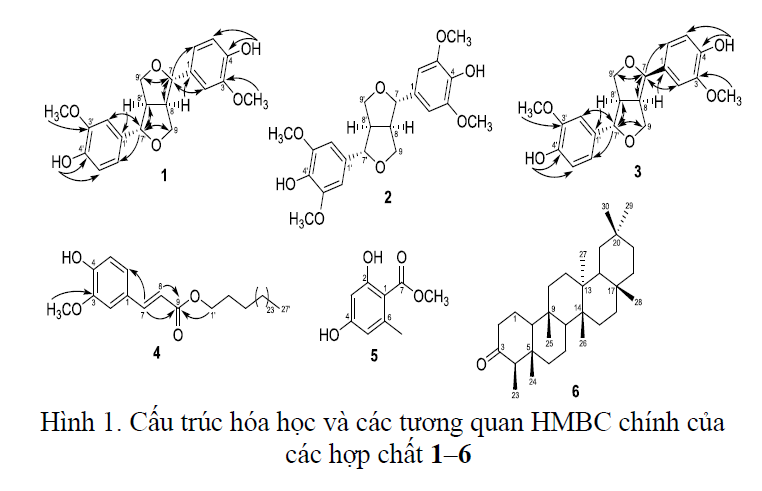
Swintonia floribunda Griff. is an evergreen tree that belongs to Anacardiaceae family, which grows at Tay Nguyen, Lam Dong, and Dong Nai Provinces in Vietnam. Swintonia floribunda showed many interesting biological activities such as antitumor effect against breast and pancreatic cancers, antioxidant, and antimicrobial activities. From the stem barks of Swintonia floribunda Griff. (Anacardiaceae) collected in Dong Nai province, three epoxylignans: pinoresinol (1), syringaresinol (2), epipinoresinol (3), together with three other compounds: n-heptacosyl trans-ferulate (4), methyl orsellinate (5), and friedelin (6) have been isolated from the EtOAc-soluble extract. The chemical structure of these compounds were determined by 1D and 2D NMR spectra and comparison with published data. These compounds were first reported in Swintonia floribunda