


Multi-objective 1D magnetotelluric inversion using Pareto front and knee-point selection for multi-layered geoelectric structure
- Ho Chi Minh City University of Technology and Engineering, Vietnam
Abstract
In this study, the one-dimensional magnetotelluric (MT1D) inversion problem for a multi-layered medium (30 layers) is addressed using a multi-objective optimization approach based on the weighted sum method. The MT1D inversion aims to determine the resistivity distribution with depth from observed apparent resistivity and phase data, in which two conflicting objective functions must be minimized simultaneously: the roughness of the resistivity model and the misfit between observed and calculated data, quantified by the root mean square error (RMSE). These two objectives are combined into a single objective function through systematically varied weighting factors to investigate the trade-off between model smoothness and the level of agreement between observed and modeled data. This formulation transforms the original two-objective optimization problem (roughness and RMSE) into a single-objective optimization problem based on their weighted sum.
The resulting single-objective optimization problem is solved using a modified differential evolution (MDE) algorithm, a global optimization method that does not require derivative information and is less sensitive to the initial model compared to traditional approaches. By performing inversions with different pairs of weighting factors, a Pareto front is constructed to characterize the trade-off relationship between the two objective functions. The optimal solution is then selected based on the knee-point criterion, which provides a balanced compromise between model smoothness and data misfit.
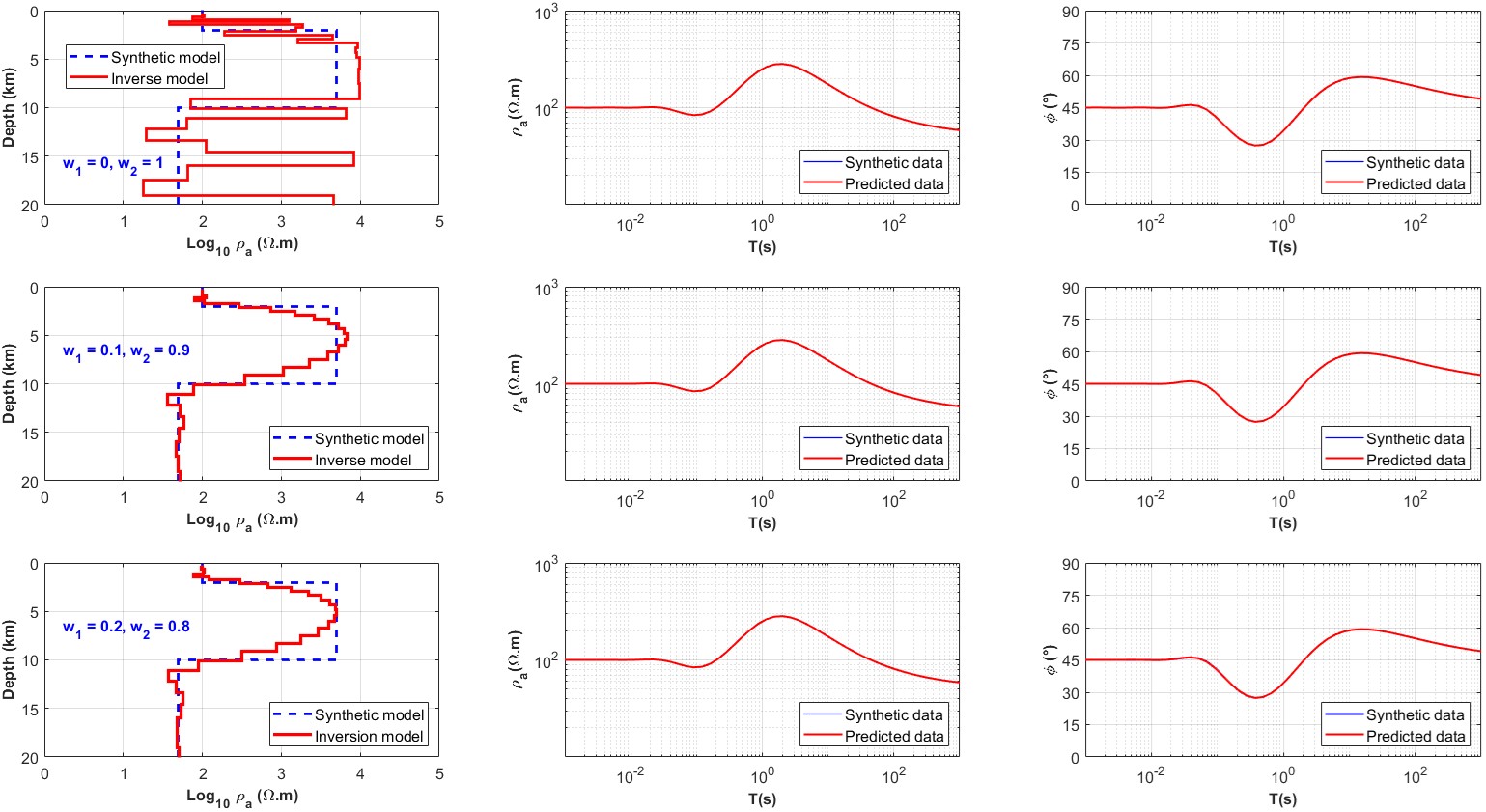
The proposed method is first validated using a synthetic three-layer model, demonstrating that the recovered resistivity-depth profile accurately reflects the true structure. It is then applied to real data from the C12 site in the Cu Chi area, Ho Chi Minh City. The inversion results are in good agreement with previously published studies. The results indicate that the method is effective and reliable for 1D MT inversion and has strong potential for extension to other geophysical inversion problems.