


Fabrication of MoS2-MoO3.H2O thin film on fto substrate by electrodeposition method combining with heat treatment as electrode for hydrogen evolution reaction (HER)
- University of Science, Ho Chi Minh City, Vietnam
- Vietnam National University Ho Chi Minh City, Vietnam
Abstract
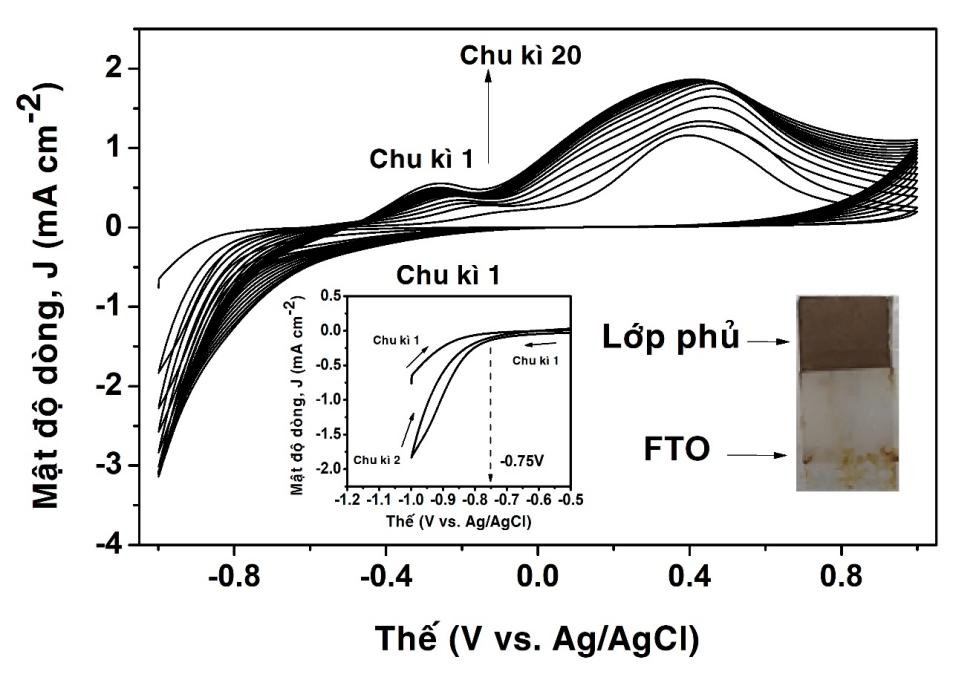
Green hydrogen production via water-splitting technology holds promise for the future of a hydrogen-based economy and addresses climate change caused using fossil fuels. Current research focuses on developing new catalytic materials from abundant natural resources and cost-effective sources to replace noble metal-based catalysts. Among them, (MoS2 is a potential catalyst for water splitting, which can be synthesized from molybdenum, a transition metal with high natural abundance. This paper presents the development of an electrochemical deposition process using the cyclic voltammetry (CV) method to fabricate molybdenum disulfide–molybdenum trioxide (MoS2-MoO3.H2O) hybrid films on FTO substrates in a simple and low-cost single step. The initially amorphous films could crystallize at a relatively low temperature (120 oC), unlike conventional methods that required higher temperatures. Accordingly, a thin MoS2-MoO3.H2O film (500 nm) was electrochemically deposited on conductive glass FTO substrates (denoted MoS2-MoO3.H2O /FTO) from an electrolyte solution containing 5 mM (NH4)6Mo7O24 30 g/L Na2S and 0.1 M KCl using the CV method. The electrocatalytic activity of the MoS2-MoO3.H2O /FTO electrode for the hydrogen evolution reaction (HER) was evaluated in 0.5 M H2SO4 using linear sweep voltammetry (LSV). The films formed by CV exhibited a brown color and an amorphous structure. After the thermal treatment at 120 oC, the amorphous structure transformed into a crystalline structure, comprising MoS2 and MoO3.H2O phases. LSV results showed that the electrocatalytic activity of the electrode significantly improved after heat treatment at 120 °C, with a Tafel slope of 80 mV/dec and a 2.75-fold increase in current density compared to the untreated electrode. The fabricated MoS2-MoO3.H2O /FTO electrode exhibited high catalytic activity and stability in 0.5 M H2SO4 These results demonstrated that MoS2-MoO3.H2O /FTO was a promising, easily fabricated catalytic system suitable for green hydrogen applications.