


Structural analysis and stability assessment of the surface-modified biodegradable porous nano silica with polyethylene glycol
- Faculty of Biology and Biotechnology, University of Science, Ho Chi Minh City, Vietnam
- Center for Innovative Materials and Architectures (INOMAR), Vietnam National University, Ho Chi Minh City, Vietnam
- Vietnam National University, Ho Chi Minh City, Vietnam
- Center for Innovative Materials and Architectures (INOMAR), Vietnam National University, Ho Chi Minh City
Abstract
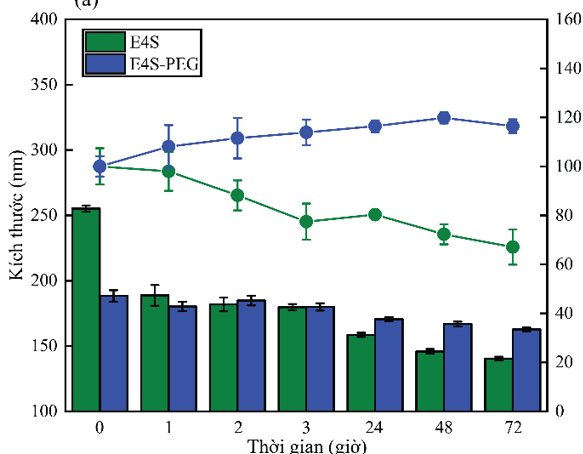
This study details the surface modification of biodegradable porous organosilica nanomaterials (E4S) with polyethylene glycol (PEG) to enhance its stability for camptothecin (CPT) delivery. The material is synthesized by the sol-gel method from two organic silane precursors and post-synthesized functionalization with PEG. The synthesized material was characterized using N2 adsorption-desorption isotherms, thermogravimetric analysis (TGA), and zeta potential measurement. Scanning electron microscopy (SEM) images show the particle size remained relatively unchanged, around 100 nm, before and after functionalization. Elemental analysis (EA) further validated the successful modification of PEG onto E4S through changes in elemental percentages. The ability to successfully load CPT onto the materials was demonstrated through UV-vis absorption spectroscopy results and the loading capacity was calculated from UV detector high-performance liquid chromatography (HPLC) results. The CPT drug loading capacity of E4S and E4S-PEG materials is 88.83 ± 3.63 mg/g and 74.19 ± 5.09 mg/g, respectively. Furthermore, dynamic light scattering (DLS) results demonstrated that E4S-PEG exhibited improved stability and dispersion compared to E4S material through 72 hours of testing, thereby enhancing its potential in disease treatment applications.