


Characterization and rhodamine B adsorption of hydrochar made from the distilled waste of lemongrass
- TNUS- Thai Nguyen University
Abstract
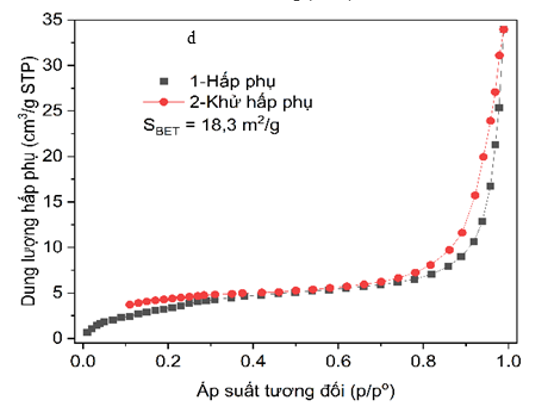
In this study, the distilled waste of lemongrass has been carbonized by hydrothermal treatment at 240oC for 5 h then activated with 5 M KOH at room temperature for 24 hours. The prepared hydrochars were characterized by scanning electron microscopy-energy dispersive spectroscopy (SEM-EDS), Fourier transform infrared spectroscopy (FTIR), and Brunauer- Emmet - Teller (BET). The results show that the main component of hydrochar is C (~77%), increased significantly compared to the distilled waste of lemongrass (~67%); the hydrochar still maintained functional groups such as C=C, C=O, C-O-C, C-C… with a BET surface area of 18.3 m2g-1. Some factors affecting the adsorption process of Rhodamine B (RhB) by the prepared hydrochar were investigated, including pH, initial RhB concentration, adsorbent dosage, contact time, and temperature. The maximum efficiency achieved was the adsorption of 10 mg/L RhB by 5 g/L of hydrochar at pH 78, approximately 94%, qmax of 14.93 mg/g. The adsorption isotherm was well described by the Freundlich isotherm model and pseudo-second-order reaction kinetics. The adsorption is spontaneous, endothermic, and with increased entropy. This indicates that the adsorption mechanism includes both physical and chemical adsorption. The results demonstrate that the hydrochar obtained from the distilled waste of lemongrass is an effective RhB adsorbent.