


Optoelectronic properties of small type II CDTE-ZNSE quantum dots passivated by INF3 ligands

- FPT University, 600 Nguyen Van Cu, Ninh Kieu District, Can Tho, Vietnam
- Can Tho University, 3/2 Street, Ninh Kieu District, Can Tho, Vietnam
- School of Education, Can Tho University, Vietnam
Abstract
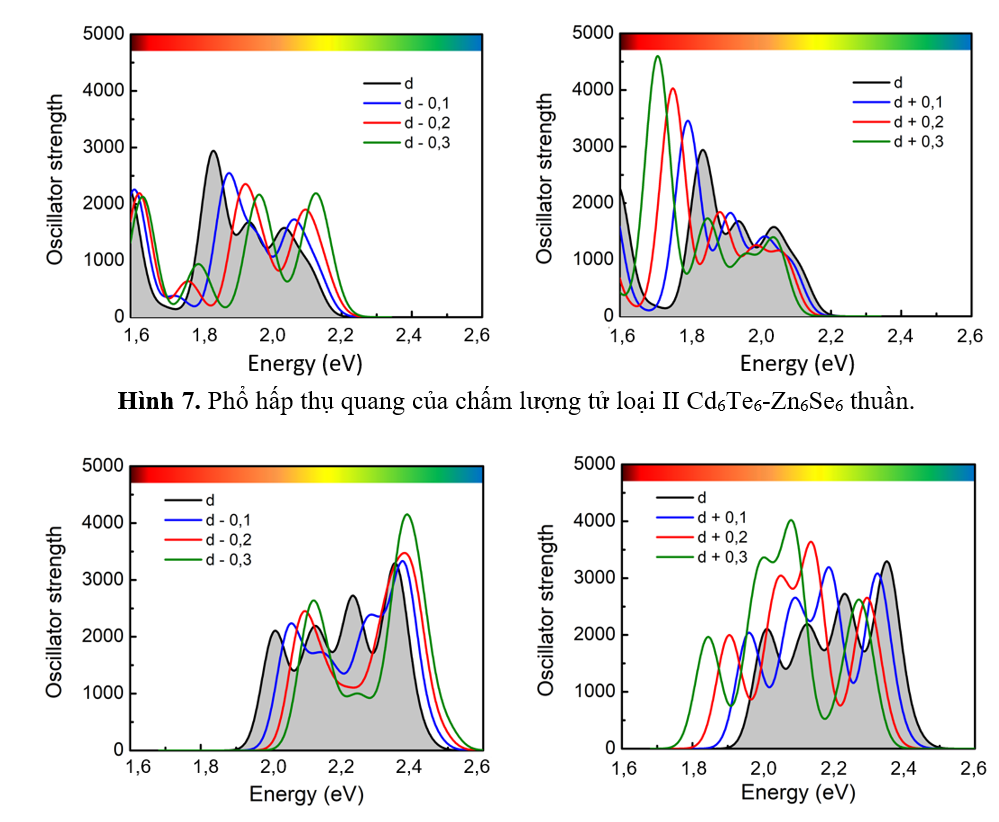
In this study, we employ first-principles methods with density functional theory including the spin-orbit coupling effect to investigate the optoelectronic properties of pristine and InF3-ligand-assisted CdTe-ZnSe type II quantum dots. We show that when attaching InF3 ligands to type II CdTe-ZnSe quantum dots, the optical absorption spectra of these dots is red-shifted towards the lower energy range with respect to that of the pristine CdTe-ZnSe quantum dots. When we actively increase or decrease the distances between the two single dots inside a type II quantum dot, their band gaps also increase or decrease accordingly. Upon attaching InF3 ligands, the band gap of this quantum dot performs a small blue shift compared to the corresponding pristine quantum dot sample. By increasing the distances between the two interior CdTe and ZnSe portions inside the CdTe-ZnSe dots, due to the charge transfer from the ligands to the interior portions, the absorption spectra exhibit a red-shift with a significant increase of the absorption intensity with respect to the case of the pristine type II quantum dots. The results demonstrate the essence of InF3 ligands to enhance the light absorption capacity resulting in improving the light-to-electricity conversion efficiency of solar panels embedding CdTe-ZnSe type II quantum dots.