


Preparation of magnetic nanoparticles as photo‒Fenton catalysts by a hydrothermal‒assisted thermal treatment method
- University of Science, VNU-HCM
Abstract
The magnetic CoFe2O4 nanoparticles, prepared by hydrothermal method combining with the heat treatment at 600oC, were used to act as a photo‒Fenton catalyst in the methylene blue (MB) degradation reaction. The composition, structure, and surface morphology of the prepared materials were studied by X-ray diffraction (XRD), Fourier-transform infrared (FT-IR) spectroscopy, field-emission scanning electron microscopy (FESEM), and energy-dispersive X-ray (EDX) spectroscopy. The optical properties of CoFe2O4 before and after calcination, analyzed by UV-Vis diffuse reflectance (DRS) spectroscopy, demonstrated that after heating at 600oC, the structure and crystallinity of CoFe2O4 were increased. The calcination process also caused the CoFe2O4 sintering to grow to a larger size, thereby reducing the surface area of the CoFe2O4 after calcination compared to the original ones. This value was determined through nitrogen the adsorption‒desorption isotherms curve. The magnetism of CoFe2O4 before and after calcination was studied by vibrating sample magnetometer (VSM). After sintering at 600oC, the saturation magnetization (Ms) and residual magnetism (Mr) of CoFe2O4 were higher than those of the original. The Fenton photocatalytic performance was evaluated by MB degradation reaction under UVA radiation in the presence of oxalic acid as an active free radical generating agent. In the methylene blue degradation reaction at room temperature, the prepared CoFe2O4 catalyst showed the maximum degradation efficiency of 97% for MB and the reaction yields were almost unchanged after three consecutive reactions. This method promised in making ferrite materials for water treatment based on some advantages such as simple process, low cost, and environmentally friendly solvent usage.
MỞ ĐẦU
Hiện nay, ô nhiễm môi trường, đặc biệt là ô nhiễm nguồn nước do các loại phẩm nhuộm hữu cơ đang là một vấn nạn cấp thiết. Đây là loại hóa chất được sử dụng phổ biến cho ngành dệt may cùng nhiều ngành công nghiệp khác như sản xuất da, nhựa, mỹ phẩm, thực phẩm, công nghiệp in và dược phẩm. Phẩm nhuộm hữu cơ có cấu tạo gồm các vòng benzene cùng các nhóm phức chất mang màu, khá bền và không bị phân hủy ở điều kiện thông thường. Đây là các hóa chất độc hại, tác động tiêu cực đến môi trường sống của con người và hệ sinh thái1. Khi nồng độ phẩm nhuộm trong nước quá cao sẽ gây cản trở sự hấp thụ oxi từ không khí vào nước. Điều này làm ảnh hưởng quá trình sinh trưởng của các động thực vật, gây ra hiện tượng xáo trộn hoạt động của vi sinh vật và ảnh hưởng đến quá trình tự làm sạch của nước.
Cho đến nay, đã có rất nhiều giải pháp được phát triển để giải quyết vấn đề này2, 3, 4, 5, 6. Trong số đó, phương pháp đang được nghiên cứu nhiều là sử dụng các chất xúc tác quang hóa để phân hủy phẩm nhuộm dưới sự kích thích của năng lượng ánh sáng. Trong phương pháp này, chất xúc tác hỗ trợ các gốc hydroxyl (•OH) hoạt tính cao, có nguồn gốc từ ozone hoặc peroxide (HO), tác kích vào các phân tử phẩm nhuộm hữu cơ, từ đó trung hòa và phân hủy các hợp chất ô nhiễm này. Ưu điểm của phương pháp này là quy trình thực hiện đơn giản, hiệu quả cao và chi phí thấp. Nhiều loại xúc tác, thí dụ TiO7, FeZnO8, SnO9, ZnO10, 11, CeO12, FeO13, 14, FeO15, MnFeO16 và MnO17, đã được sử dụng để đẩy nhanh quá trình tạo ra các gốc •OH hoạt tính. Tuy nhiên, khả năng thu hồi và tái sử dụng của các loại xúc tác này vẫn đang là một thách thức. Giải quyết được thách thức này không những mang lại giá trị về mặt kinh tế, mà còn ngăn chặn sự phát sinh của các nguồn ô nhiễm thứ cấp, được sinh ra do sự tồn dư của các chất xúc tác không được thu hồi sau các quá trình xử lý. Chính vì nguyên nhân này, mà hiện nay rất nhiều vật liệu xúc tác từ tính, có khả năng thu hồi bằng từ trường ngoài và có thể tái sử dụng đang rất được quan tâm nghiên cứu. Trong số đó thì vật liệu spinel ferrite với công thức MFeO, trong đó M là những ion kim loại hóa trị II (M = Zn, Cu, Co, Ni, Mn…), mà cụ thể là cobalt ferrite (CoFeO) là một lựa chọn thích hợp. Đây là loại vật liệu từ cứng, với các tính chất như hằng số dị hướng cao, độ từ hóa bão hòa cao, từ tính cao, ổn định hóa học cùng quy trình tổng hợp đơn giản18, 19. Theo một số nghiên cứu gần đây, hạt nano CoFeO cho thấy có hoạt tính xúc tác phân hủy phẩm nhuộm vượt trội hơn so với các oxide kim loại như FeO, FeO và MnO20, 21.
Nhiều phương pháp đã được phát triển để tổng hợp vật liệu CoFeO như đồng kết tủa, vi nhũ tương, sol-gel, thủy nhiệt, phân hủy nhiệt, hóa siêu âm,…22. Phương pháp nào cũng có những ưu và nhược điểm nhất định và đều ảnh hưởng đến hình thái, kích thước cùng các tính chất hóa lý, từ tính và các đặc trưng bề mặt của vật liệu23. Trong số đó, thủy nhiệt là một trong những phương pháp phổ biến để tổng hợp hạt nano CoFeO. Một số ưu điểm của thủy nhiệt có thể kể đến là dung môi sử dụng là nước thân thiện với môi trường, chi phí thấp, khả năng kiểm soát hình thái cùng hiệu suất tương đối cao24, 25. Tuy nhiên, nhược điểm của phương pháp này là thường đòi hỏi áp suất và nhiệt độ cao cùng thời gian phản ứng dài. Riêng đối với CoFeO thì kích thước tinh thể và tính chất từ bị ảnh hưởng rất nhiều vào thời gian tổng hợp. Một số nghiên cứu đã cố gắng cải thiện tính chất từ của tinh thể nano CoFeO bằng cách nung ở nhiệt độ cao sau khi tổng hợp26, 27. Ở nhiệt độ cao, diễn ra quá trình thiêu kết và tăng trưởng các hạt CoFeO ở kích thước lớn hơn, điều này dẫn đến tỷ lệ giữa diện tích bề mặt và thể tích hạt giảm, từ đó làm tăng độ từ hóa bão hòa (M) của vật liệu28.
Bài báo trình bày, vật liệu CoFeO dạng hạt, có kích thước nanometer, được chế tạo bằng phương pháp thủy nhiệt, và tiếp đến được xử lý nhiệt ở nhiệt độ 600C. Quá trình thủy nhiệt được tiến hành tại áp suất khí quyển cùng nhiệt độ tương đối thấp và thời gian ngắn. Điều này giúp hạn chế những nhược điểm của phương pháp thủy nhiệt như đã đề cập đến ở trên. Sau khi thủy nhiệt, các mầm kết tinh của CoFeOđược nung ở 600C trong 2 giờ để thiêu kết tạo thành hạt có kích thước lớn hơn, giúp cải thiện từ tính của vật liệu. CoFeO sau khi chế tạo được khảo sát hoạt tính xúc tác Fenton quang hóa phân hủy phẩm nhuộm methylene blue trong điều kiện có mặt tác chất oxalic acid (HCO) dưới bức xạ UVA.
VẬT LIỆU VÀ PHƯƠNG PHÁP
Vật liệu
Phẩm nhuộm methylene blue (CHNSCl), NaOH, HCO (AO) cùng hai tiền chất của cobalt và sắt là cobalt (II) nitrate hexahydrate (Co(NO).6HO) và iron (III) chloride hexahydrate (FeCl.6HO) đều là dạng thương mại có xuất xứ Trung Quốc. Ethanol (CHOH) là dung môi tinh khiết được cung cấp bởi hãng Chemsol, Việt Nam. Tất cả hóa chất được sử dụng trực tiếp, không cần phải tinh chế lại và nước khử ion (nước DI) được sử dụng để pha các dung dịch trong quá trình thực nghiệm.
Phương pháp phân tích
Phổ hồng ngoại biến đổi Fourier (FT-IR) được phân tích trong vùng số sóng từ 4000–400 cm, ở độ phân giải là 4 cm trên thiết bị quang phổ Themo Fisher SCIENTIFIC (Mỹ). Một lượng nhỏ mẫu dạng bột (2–3 mg) được ép viên với KBr ở lực nén 250 kN. Tỷ lệ khối lượng mẫu và KBr là 1:100. Giản đồ nhiễu xạ tia X (XRD) giúp xác định cấu trúc tinh thể và thành phần pha của các mẫu dạng bột được phân tích trên máy D2 PHARSER (Bruker, Đức), với góc quét 2θ từ 10° đến 80° và bước chuyển 0,02°/phút. Hình thái bề mặt vật liệu được phân tích bằng ảnh FESEM trên thiết bị S–4800 với thế gia tốc 10 kV. Hàm lượng cũng như sự phân bố các nguyên tố hiện diện trên bề mặt được xác định thông qua phổ EDX, sử dụng hệ EMAX ENERGY kết hợp trên thiết bị S-4800. Đặc tính quang học và giá trị năng lượng vùng cấm (E) của vật liệu được xác định bằng phổ phản xạ khuếch tán tử ngoại khả kiến UV-Vis (DRS), đo trên máy quang phổ Perkin–Elmer Lambda 850.
Các giá trị độ từ hóa bão hòa (M), độ từ dư (M), lực kháng từ (H) và đường cong từ trễ được phân tích bằng phương pháp từ kế mẫu rung (VSM) trên thiết bị System ID: EV11, SN:2010062. Phép phân tích được thực hiện tại nhiệt độ phòng với giá trị từ trường ngoài -12000 đến +12000 Oe. Hoạt tính Fenton quang xúc tác của vật liệu được khảo sát dựa trên quá trình phân hủy phẩm nhuộm methylene blue. Hàm lượng MB còn lại được xác định bằng phương pháp trắc quang. Phân tích trắc quang được thực hiện trên máy quang phổ Helios Omega UV-Vis (Thermo Fisher Scientific, USA).
Tổng hợp CoFeObằng phương pháp thủy nhiệt kết hợp xử lý nhiệt
Quy trình tổng hợp CoFeO được thực hiện tuần tự theo các bước theo mô tả trên Figure 1. Đầu tiên, cho lần lượt hai muối kim loại gồm 3,410 g Co(NO).6HO và 6,320 g FeCl.6HO vào 10,0 mL nước DI (tỉ lệ mol hai muối Co và Fe là 1:2). Hỗn hợp được đánh siêu âm đến khi các chất rắn tan hoàn toàn. Tiếp đến, 100 mL dung dịch NaOH 1M được thêm vào dung dịch trên và dung dịch tiếp tục được đánh siêu âm thêm 1 giờ. Sau quá trình này, trong dung dịch đã xuất hiện kết tủa. Kết tủa sau đó được để lắng và phần dung dịch phía trên được gạn bỏ. Quá trình lắng, gạn rửa kết tủa được tiến hành tiếp tục cho đến khi còn lại 60 mL hỗn hợp có pH 7. Sau đó, hỗn hợp được cho vào bình Teflon-thép không gỉ và được thủy nhiệt ở 150C trong 4 giờ. Kết thúc thời gian, hệ thủy nhiệt được làm nguội đến nhiệt độ phòng. Chất rắn sau phản ứng được lọc, rửa nhiều lần bằng nước DI và ethanol; sau đó được sấy khô ở 90C, thu được mẫu bột màu đen (CFO). Sản phẩm tiếp tục được đem nung ở nhiệt độ 600C trong 2 giờ ở môi trường không khí với tốc độ gia nhiệt 10C/phút. Vật liệu sau giai đoạn này được ký hiệu là CFO-600.

Quy trình tổng hợp CFO và CFO-600
Khảo sát hoạt tính xúc tác phân hủy MB
Hoạt tính Fenton quang xúc tác của vật liệu CoFeO được đánh giá bằng quá trình phân hủy MB với tác nhân tạo gốc tự do là HCO (10 mol.L). Phản ứng xảy ra dưới bức xạ kích thích UVA (320 < λ < 400 nm). Quá trình được thực hiện bằng cách cho 0,050 g chất xúc tác vào 250 mL dung dịch có chứa MB (5×10 mol.L) và HCO (10 mol.L). Hỗn hợp phản ứng có giá trị pH ở khoảng 7 và được khuấy liên tục bằng máy khuấy trục IKA RW 20 digital. Nhiệt độ phản ứng luôn được duy trì ở 29‒31C bằng bể điều nhiệt Memmert (Đức) trong suốt quá trình khảo sát. Hỗn hợp được khuấy đều trong bóng tối suốt 25 phút để đảm bảo quá trình hấp phụ phẩm nhuộm lên bề mặt xúc tác đạt trạng thái cân bằng (thời gian cân bằng hấp phụ 25 phút được xác định thông qua các khảo sát sơ bộ trước đó, khi theo dõi nồng độ MB ban đầu gần như không thay đổi trong hệ xúc tác dưới điều kiện không chiếu sáng). Sau đó, hệ phản ứng được chiếu sáng bằng bóng đèn UVA (9 W Radium 78). Sau mỗi 5 phút, 10 mL dung dịch được rút ra khỏi hệ, xúc tác được tách ra khỏi dung dịch này bằng nam châm đất hiếm. Nồng độ MB còn lại trong dung dịch được xác định bằng phương pháp phổ hấp thu UV–VIS ở bước sóng 664 nm trên thiết bị Helios Omega UV–VIS (Thermo Fisher Scientific, USA). Từ giá trị độ hấp thu và dựa vào đường chuẩn của MB để xác định nồng độ MB còn lại trong dung dịch. Khả năng phân hủy MB được tính theo công thức (1) như sau:
Khả năng phân hủy = (1)
Trong đó C và C lần lượt là nồng độ tại thời điểm t và nồng độ ban đầu của MB.

Giản đồ XRD của CFO và CFO-600
KẾT QUẢ THẢO LUẬN
Giản đồ XRD
Giản đồ XRD của mẫu CFO ở Figure 2 cho thấy các đỉnh nhiễu xạ tại vị trí góc 2θ = 18,3; 30,1; 35,5; 37,1; 43,1; 53,5; 57,0; 62,6 ;74,0 và 79,0 tương ứng với các mặt mạng (111), (220), (311), (222), (400), (422), (511), (440), (533) và (444), đặc trưng cho cấu trúc spinel ferrite của CoFeO (JCPDS no. 022-1086) 29. Tuy nhiên, hình dạng các đỉnh nhiễu xạ của mẫu CFO không rõ ràng, cường độ yếu và bề rộng của đỉnh lớn. Sau quá trình thiêu kết ở 600C thì hình dạng các đỉnh trở nên sắc nét, cường độ đỉnh tăng trong khi đó bề rộng của đỉnh hẹp hơn so với mẫu CFO ban đầu. Điều này cho thấy sau quá trình thiêu kết, cấu trúc tinh thể của CFO được cải thiện. Tuy nhiên, giản đồ XRD của CFO-600 có xuất hiện một đỉnh nhiễu xạ mới ở vị trí 2θ = 33,2. Đây được cho là tín hiệu đặc trưng cho mặt mạng (104) trong cấu trúc tinh thể của pha hematite (α-FeO), được hình thành trong quá trình nung CFO ở nhiệt độ cao.
Kích thước tinh thể của CFO và CFO-600 được tính toán từ giản đồ XRD theo công thức Debye-Scherrer: . Trong đó D là kích thước tinh thể, λ là bước sóng của bức xạ tia X (1,5406 Å), β là độ bán rộng của đỉnh nhiễu xạ (FWHM) và θ là góc nhiễu xạ Bragg đo bằng radian. Kết quả xác định CFO có kích thước tinh thể là 12,25 nm, còn đối với CFO-600 là 22,50 nm. Kích thước tinh thể của CFO được chế tạo từ phương pháp thủy nhiệt này có giá trị xấp xỉ so với vật liệu cùng loại được chế tạo bằng phương pháp nhiệt dung môi30, lớn hơn so với khi chế tạo bằng phương pháp đồng kết tủa31, polyol32 và nhỏ hơn so với khi được chế tạo bằng phương pháp phân hủy nhiệt33, 34, 35, sol-gel 36.
Phổ FT-IR
Kết quả phổ FT-IR của CFO và CFO-600 được thể hiện trên Figure 3. Mũi hấp thu dạng bầu, rộng trong vùng số sóng 3500–3400 cm và mũi tại 1640 cm là đặc trưng cho dao động kéo dãn và biến dạng của liên kết O-H trong nước được hấp phụ trong vật liệu. So với CFO, hai mũi hấp thu này của CFO-600 có cường độ yếu hơn nhiều. Điều này cho thấy sau quá trình nung ở nhiệt độ cao, lượng nước trong vật liệu đã được loại bỏ gần như hoàn toàn. Mũi hấp thu tại 1384 cm trong CFO là dao động kéo dãn của nhóm CO, xuất hiện do các oxide sắt (III) hoặc sắt (III) hydroxide bị carbon hóa bởi CO trong không khí 37. Mũi này xuất hiện trong CFO và gần như mất hẳn trong mẫu CFO-600. Điều này cho thấy hợp chất Fe(CO) đã bị phân hủy với O trong không khí khi vật liệu được thiêu kết ở nhiệt độ cao. Các mũi hấp thu tại số sóng 1140 cm và 1099 cm đặc trưng cho dao động kéo dãn của Fe-Co38 trong CoFeO. Cả CFO và CFO-600 đều có các mũi hấp thu mạnh trong vùng 587–577 cm, đặc trưng cho dao động kéo dãn của liên kết kim loại-oxy trong cấu trúc tứ diện (M-O); trong khi đó dao động kéo dãn của liên kết kim loại-oxy trong cấu trúc bát diện (M-O) làm xuất hiện mũi hấp thu trong vùng 419–401 cm. M-O có số sóng cao hơn số sóng của M-O, do giá trị độ dài liên kết của M-O nhỏ hơn của M-O39. Ngoài ra, phổ FT-IR của CFO-600 còn phát hiện một mũi vai có cường độ yếu tại 467 cm đặc trưng cho dao động kéo dãn liên kết Fe-O của pha hematite (α-FeO) tồn tại trong cấu trúc40. Kết quả này phù hợp với phân tích XRD ở trên, quá trình nung CFO ở 600C đã làm xuất hiện thêm pha hematite (α-FeO) trong cấu trúc tinh thể của CoFeO.
Phổ EDX và ảnh FESEM
Thành phần và hàm lượng các nguyên tố trên bề mặt của CFO và CFO-600 được phân tích bằng phổ EDX (Figure 4). Kết quả phổ EDX của vật liệu đã xác minh sự hiện diện của Co, Fe và O đồng thời không phát hiện các nguyên tố khác ngoài ba nguyên tố kể trên trong cấu trúc của CFO và CFO-600. Tỉ lệ giữa nguyên tố Co và Fe trong CFO và CFO-600 (khoảng 0,5) phù hợp với tỉ lệ mol của hai tiền chất muối Co và Fe sử dụng trong quá trình tổng hợp. Điều này cho thấy vật liệu sau quá trình thủy nhiệt có độ tinh khiết cao.

Phổ FT-IR của CFO và CFO-600

Phổ EDX của của CFO và CFO-600
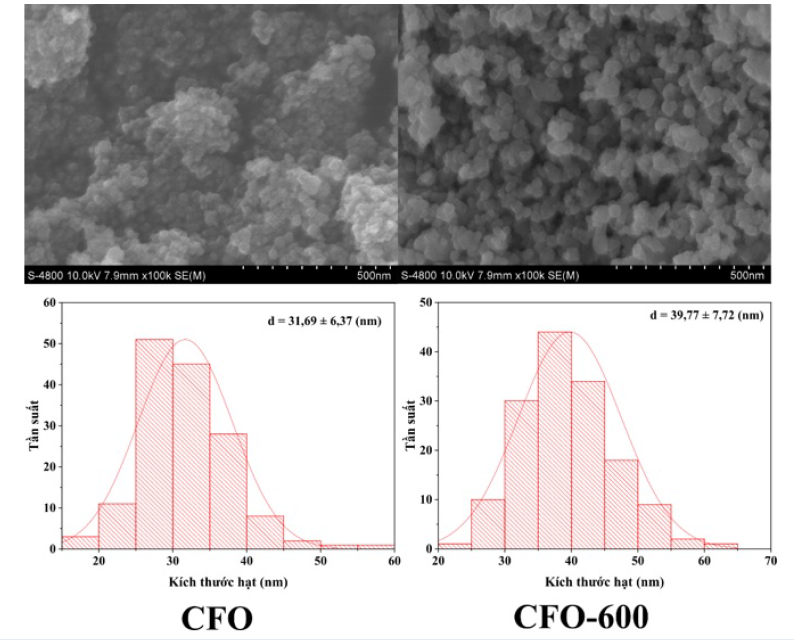
Figure 5 là ảnh FESEM thể hiện hình thái cấu trúc bề mặt cùng giản đồ phân bố kích thước của CFO và CFO-600. Vật liệu CFO chế tạo bằng phương pháp thủy nhiệt có dạng hạt, đa phân tán với kích thước trung bình khoảng 31,69 nm. Các hạt có kích thước nhỏ, năng lượng tự do bề mặt cao nên có xu hướng kết tụ lại với nhau để hình thành nên các khối, cụm lớn hơn. Khi được thiêu kết ở 600C thì hạt CFO-600 tạo thành có kích thước lớn hơn với đường kính trung bình khoảng 39,77 nm. Kích thước của hạt tăng lên có thể được giải thích thông qua cơ chế hình thành của vật liệu CFO và CFO-600 trong quá trình chế tạo. Đầu tiên, hỗn hợp hai muối gồm các cation hòa tan là Co và Fe được trộn lẫn trong dung môi là nước dưới sự hỗ trợ của siêu âm. Tiếp đến, dung dịch NaOH được thêm vào và hỗn hợp tiếp tục được đánh siêu âm trong 1 giờ. Ở giai đoạn này, trong môi trường kiềm cùng sự hỗ trợ của sóng siêu âm sẽ hình thành của các hợp chất hydroxide của Co và Fe. Hỗn hợp sau đó được lắng, lọc rửa bằng nước DI đến pH 7 và được thủy nhiệt ở 150C trong 240 phút. Trong quá trình thủy nhiệt, các hợp chất hydroxide của Co và Fe sẽ khử nước, tạo các mầm kết tinh và phát triển thành các tinh thể CFO. Vật liệu CFO sau đó được nung ở 600C trong 2 giờ. Trong quá trình nung này đã diễn ra hiện tượng thiêu kết hạt, các hạt CFO nhận năng lượng nhiệt để kết dính lại với nhau và tạo thành hạt CFO-600 có kích thước lớn hơn.

Ảnh FESEM và biểu đồ phân bố kích thước của CFO và CFO-600
Xác định diện tích bề mặt bằng phép đo hấp phụ N (BET)

Đường cong hấp phụ‒giải hấp phụ nitrogen của CFO và CFO-600
Đường cong hấp phụ‒giải hấp phụ nitrogen của CFO và CFO-600 được thể hiện trên Figure 6. Kết quả phân tích cho thấy, các đường hấp phụ và giải hấp phụ có hình dạng thuộc dạng IV, vòng lặp trễ H3 theo phân loại của IUPAC. Đây là tính chất đặc trưng của vật liệu mao quản trung bình, có sự xuất hiện vòng trễ gây ra bởi sự ngưng tụ mao quản. Ở đây, vòng trễ ở áp suất cao cho biết sự hiện diện của kích thước lỗ trống lớn với kích thước giới hạn41. Vật liệu CFO sau khi thủy nhiệt có diện tích bề mặt riêng tính toán theo BET (S) là 99,21 m.g, lớn hơn so với khi được chế tạo bằng phương pháp phân hủy nhiệt từ dung dịch42 và nhỏ hơn khi được chế tạo bằng polyol32. Khi nung ở 600C, các hạt CFO nhận năng lượng nhiệt đã thiêu kết lại với nhau, tạo thành hạt CFO-600 có kích thước lớn và từ đó làm diện tích bề mặt của vật liệu CFO-600 nhỏ hơn. S của CFO-600 là 35,24 m.g, nhỏ hơn khoảng ~2,8 lần so với S của CFO. Tuy nhiên, giá trị này vẫn lớn hơn khá nhiều so với các công bố gần đây, khi CFO được xử lý cùng ở 600C39, 43, 44. Kết quả BET này phù hợp với ảnh FESEM của CFO và CFO-600 đã phân tích ở trên. CFO với S lớn dự kiến rằng sẽ cung cấp nhiều tâm hoạt tính xúc tác hơn so với CFO-600.
Phổ DRS
Đặc tính quang học của CFO và CFO-600 được phân tích trên phổ phản xạ khuếch tán tử ngoại khả kiến UV-Vis (DRS). Các đường cong DRS của hai vật liệu trên được hiển thị trong Figure 7. Kết quả cho thấy cả CFO và CFO-600 đều hấp thu tốt (> 80%) trong khoảng bước sóng 350–800 nm. Giá trị năng lượng vùng cấm (E) của vật liệu được xác định bằng phương pháp Tauc45 theo công thức (2):
Trong đó h là hằng số Planck, ʋ là tần số của photon, E là năng lượng vùng cấm, B là hằng số và hệ số γ = 2 đối với vật liệu CoFeO34. Biểu đồ Tauc được xác định từ công thức (2) và được thể hiện trên hình chèn nhỏ trong Figure 7. Từ biểu đồ này, các giá trị năng lượng vùng cấm (Eg) của CFO và CFO-600 được ngoại suy và có giá trị lần lượt là 1,09 eV và 1,14 eV. Kết quả cho thấy độ rộng vùng cấm của vật liệu bị ảnh hưởng rất ít bởi nhiệt độ nung.

Phổ phản xạ khuếch tán tử ngoại khả kiến UV-Vis (DRS) và đường cong αhυ2 theo năng lượng để xác định Eg của CFO và CFO-600

Đường cong VSM của CFO và CFO-600
Kết quả VSM
Kết quả đo từ tính của CFO và CFO-600 bằng phương pháp VSM được thể hiện qua đường cong từ trễ cùng các giá trị độ từ hóa bão hòa (M), độ từ dư (M) và lực kháng từ (H) được cho trong bảng trên Figure 8. Giá trị Ms của CFO sau khi thủy nhiệt là 32,3 emu.g, Giá trị này thấp hơn so với khi chế tạo CFO bằng phương pháp nhiệt truyền thống, phương pháp gia nhiệt bằng vi sóng46 sol-gel 47, polyol32 hay là đồng kết tủa, sau đó mới xử lý nhiệt48. Nguyên nhân là các phương pháp trên tạo ra vật liệu CFO có kích thước tinh thể lớn hơn. Sau quá trình thiêu kết ở 600C thì kích thước tinh thể của CFO tăng nên CFO-600 có giá trị M cao hơn so với CFO. Giá trị này cũng cao hơn so với các công bố gần đây, khi CFO được xử lý cùng ở 600C 43, 49. Kết quả FESEM cũng cho thấy các hạt CFO đã thiêu kết nhiệt để tạo thành hạt CFO-600 có kích thước lớn hơn. Kích thước hạt tăng dẫn đến kích thước của các domain từ cũng tăng và từ đó làm tăng từ tính của vật liệu39. Tuy nhiên, như đã đề cập đến trong kết quả XRD và FT-IR, trong cấu trúc tinh thể của CFO-600 có sự hiện diện của thành phần α-FeO không có từ tính. Điều này có thể làm cho giá trị H của CFO-600 lớn hơn so với CFO.
Hoạt tính xúc tác Fenton quang hóa
Kết quả khảo sát hoạt tính xúc tác của mẫu CFO trong các điều kiện khác nhau được thể hiện trong Figure 9a. Thông qua sự thay đổi nồng độ của MB, có thể thấy quá trình Fenton quang xúc tác chỉ xảy ra khi có mặt đầy đủ các yếu tố gồm CFO, dung dịch AO cùng sự kích thích của bức xạ UVA. Kết quả này chứng tỏ trong quá trình phản ứng, tâm Fe hoạt tính trên bề mặt của CFO đã tương tác với HCO để tạo ra phức chất trung gian [≡Fe(CO)]. Dưới sự kích thích của bức xạ UVA, các phức chất sẽ bị kích thích và sản sinh ra gốc tự do ●OH (phương trình 1-5 50, 51), giúp phân hủy hiệu quả phẩm nhuộm MB.

Đồ thị phân hủy MB theo thời gian khi (a) sử dụng CFO trong các điều kiện khác nhau, (b) của CFO và CFO-600
[≡Fe(CO)] + hʋ → Fe + 2CO + CO (1)
CO + O → O + 2CO (2)
O + H → HO (3)
HO + HO → HO + O (4)
Fe + HO + 3CO → [≡Fe(CO)] + OH + OH (5)
Kết quả trên Figure 9b cho thấy hiệu suất phân hủy MB của CFO dưới bức xạ UVA là 72%. Trong khi đó đối với CFO-600, hiệu suất tối đa đạt được là 97%. Quá trình nung đã giúp cho cấu trúc tinh thể của CFO được hoàn thiện, độ tinh thể hóa cao hơn dẫn đến hiệu suất Fenton quang hóa được cải thiện đáng kể. Tuy nhiên tốc độ phân hủy MB trong 30 phút đầu tiên của CFO nhanh hơn so với CFO-600. Điều này có thể được giải thích là do CFO có diện tích bề mặt lớn hơn, dẫn đến diện tích tiếp xúc giữa ion sắt (III) và oxalic acid tăng. Điều này làm quá trình tạo phức ferioxalate [Fe(CO)] xảy ra nhanh. Các phức chất sau đó hấp thu bức xạ UVA, sản sinh các gốc tự do hoạt tính để phân hủy MB.
Khả năng tái sử dụng
Khả năng tái sử dụng của vật liệu trong quá trình Fenton quang xúc tác được đánh giá thông qua khả năng phân hủy MB ở ba lần sử dụng liên tiếp nhau. Vật liệu CFO-600 sau quá trình khảo sát đầu tiên đã được thu hồi bằng nam châm đất hiếm và rửa lại ba lần với ethanol. Tiếp đến, sản phẩm rắn được cô lập, sấy khô ở 90C trong 12 giờ và thực hiện lại quá trình xúc tác trong điều kiện tương tự như ban đầu. Hoạt tính xúc tác của vật liệu sau ba lần sử dụng được thể hiện trên Figure 10. Kết quả cho thấy CFO-600 sau ba lần sử dụng đều có hoạt tính tốt, với hiệu suất lần lượt đạt 97%, 99% và 99% sau thời gian 75 phút chiếu xạ. Ngoài ra, thành phần và cấu trúc tinh thể của xúc tác CFO-600 sau khi thực hiện ba phản ứng liên tiếp nhau gần như không có sự thay đổi. Điều này được thể hiện thông qua kết quả của giản đồ XRD và phổ FT-IR của vật liệu trước và sau khi xúc tác như được trình bày tại Figure 11.

Khả năng phân hủy MB của CFO-600 ở ba lần sử dụng liên tiếp nhau
Kết quả XRD cho thấy CoFeO sau quá trình xúc tác vẫn giữ được cấu trúc đặc trưng cho cấu trúc spinel ferrite. Đỉnh nhiễu xạ ở vị trí 2θ = 33,2, đặc trưng cho pha hematite (α-FeO) vẫn còn tồn tại trong vật liệu. Thành phần của CoFeO sau xúc tác cũng không có sự thay đổi. Phổ FT-IR của CFO-600 sau xúc tác vẫn giữ nguyên các mũi hấp thu mạnh trong vùng 587–577 cm (M-O) và vùng 419–401 cm (M-O). Kết quả FT-IR của CFO-600 cũng cho thấy các mũi hấp thu đặc trưng cho nước hấp phụ trong vật liệu tại vùng 3500–3400 cm và mũi tại 1640 cm có cường độ giảm. Hiện tượng này có thể là do sau các lần phản ứng, xúc tác được cô lập, rửa bằng ethanol và sấy khô nhiều lần nên đã hạn chế lượng nước hấp phụ. Ngoài ra, mũi hấp thu tại số sóng 1140 cm đặc trưng cho dao động kéo dãn của Fe–Co trong CoFeO bị dịch chuyển về vùng có số sóng nhỏ hơn. Nguyên nhân là trong quá trình phản ứng, tâm Fe hoạt tính trên bề mặt của CFO-600 đã tương tác với HCO để tạo ra phức chất trung gian [≡Fe(CO)]. Điều này làm liên kết Fe–Co bị yếu, giúp cho liên kết này dễ dao động hơn, dẫn đến mũi hấp thu xuất hiện ở vùng có số sóng nhỏ hơn. Như vậy, các kết quả trên đã chứng tỏ rằng CFO-600 có khả năng thu hồi và tái sử dụng tốt. Ngoài ra, xúc tác được chế tạo bằng phương pháp này có độ ổn định cao trong điều kiện phản ứng. Điều này hứa hẹn mang lại hiệu quả về mặt kinh tế khi đưa vật liệu ứng dụng vào thực tế.

Giản đồ XRD (a) và phổ FT-IR (b) của CFO-600 trước và sau khi xúc tác cho phản ứng phân hủy MB
KẾT LUẬN
Vật liệu CoFeO từ tính dạng hạt, có kích thước nanometer, đã được điều chế thành công bằng quá trình thủy nhiệt kết hợp với xử lý nhiệt ở 600C trong 2 giờ. Kết quả thực nghiệm cho thấy ở giai đoạn thủy nhiệt các mầm kết tinh đã tạo ra và tăng trưởng để hình thành hạt CoFeO có kích thước nhỏ. Giai đoạn tiếp theo, khi nung ở 600C các hạt CoFeO được thiêu kết nhiệt để phát triển thành kích thước lớn hơn. Hoạt tính xúc tác Fenton quang hóa của vật liệu được đánh giá thông qua phản ứng phân hủy phẩm nhuộm methylene blue. Dưới sự kích thích của bức xạ UVA cùng sự hiện diện của oxalic acid (HCO) đóng vai trò tác nhân tạo gốc tự do, hiệu suất phân hủy MB của vật liệu đạt được là 97%, và hiệu suất hầu như không đổi qua ba lần sử dụng liên tiếp nhau. Quá trình nung sau khi thủy nhiệt không chỉ giúp cho cấu trúc và độ tinh thể hóa của CoFeO tăng lên mà từ tính của vật liệu cũng được cải thiện đáng kể. Điều này cho phép dễ dàng thu hồi xúc tác bằng nam châm sau quá trình xử lý. Như vậy, bằng phương pháp thủy nhiệt kết hợp với xử lý nhiệt, CoFeO tạo thành không chỉ có hoạt tính xúc tác được cải thiện mà từ tính của vật liệu cũng tốt hơn. Với những ưu điểm như quy trình đơn giản, chi phí thấp và chỉ sử dụng các dung môi thân thiện với môi trường, phương pháp này hứa hẹn mang lại hiệu quả trong việc chế tạo vật liệu ferrite nói chung và CoFeO nói riêng trong việc định hướng ứng dụng trong xử lý môi trường nước.
LỜI CẢM ƠN
Nghiên cứu được tài trợ bởi Đại học Quốc gia Thành phố Hồ Chí Minh (ĐHQG-HCM) trong khuôn khổ Đề tài mã số VL2022-18-04. Nhóm tác giả xin chân thành cám ơn.
DANH MỤC TỪ VIẾT TẮT
DRS:Phổ phản xạ khuếch tán tử ngoại khả kiến UV-Vis
EDX:Phổ tán sắc năng lượng tia X
FESEM:Kính hiển vi điện tử quét phát xạ trường
FT-IR:Phổ hồng ngoại biến đổi Fourier
MB:Methylene Blue
UV-Vis:Phổ tử ngoại-khả kiến
VSM:Phương pháp từ kế mẫu rung
XRD:Nhiễu xạ tia X
XUNG ĐỘT LỢI ÍCH
Nhóm tác giả cam kết không có xung đột lợi ích
ĐÓNG GÓP CỦA CÁC TÁC GIẢ
Lê Thị Ngọc Hoa, Nguyễn Ngọc Vi Khánh, Lê Đặng Thanh An,Đặng Tấn Phát, Đỗ Ngọc Hậu: thực nghiệm
Vũ Năng An, Lê Văn Hiếu: chuẩn bị bản thảo và chỉnh sửa/phản hồi phản biện, hoàn chỉnh bản thảo.